Before the Work Order: The Future of Maintenance Intelligence.
Most maintenance conversations start at the work order. A resident reports a problem, a work order gets created, and the team reacts. By that point, the decisions that matter most (timing, scope, repair versus replace) have usually been made by circumstance instead of by the operator.
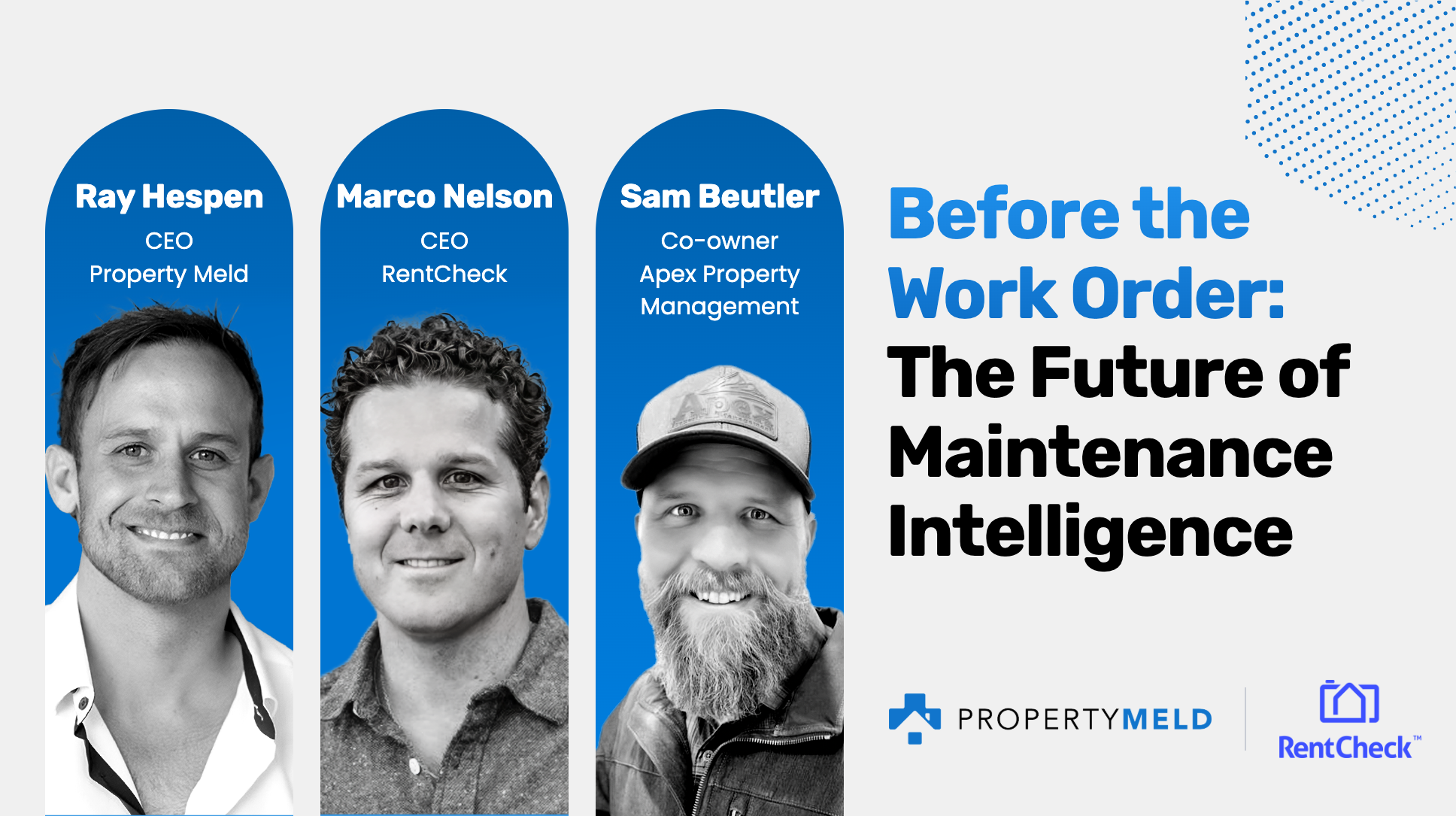
That gap was the focus of our recent webinar Before the Work Order: The Future of Maintenance Intelligence.
The panel, featuring Property Meld CEO Ray Hespen, RentCheck founder and CEO Marco Nelson, and Apex Property Management co-owner Sam Beutler, made a clear case: the operators winning on cost, retention, and owner trust are the ones who start before the request comes in.
Reactive maintenance quietly gives away the biggest decisions
When a work order is the first signal, two decisions are already gone. Timing belongs to the resident, who now expects a fix on their schedule. Scope shrinks to whatever can be done fastest, with no window to tell an owner that an appliance has failed twice, is ten years old, and should be replaced rather than repaired a third time.
The cost of that reactivity is measurable:
- HVAC repairs in peak summer months often cost about double for roughly the same work
- About 50% of repairs land in just four months of the year
Turnovers carry the same blind spot. Without a look inside before move-out, operators have no idea whether a unit needs a quick refresh or a major renovation until the resident is gone. One RentCheck partner with roughly 65,000 homes compared it to shaking a Magic 8-Ball. Adding pre-move-out inspections gave them a high-level scope ahead of time, so they could line up crews and set owner expectations before the clock started on vacancy.
The cheapest decision is the one already made
The strongest operators move decisions out of the emergency window. At Apex Property Management, furnaces limping toward winter already have owner approval and a cost range attached. When one fails, there is no scramble for estimates. A leak on a roof known to be near end of life brings a roofer quoting replacement, not a handyman sent to diagnose.
Not-to-exceed limits follow the same logic. After reviewing its own work order history, Apex raised its threshold to cover recurring jobs like dishwashers, microwaves, and garbage disposals. Those repairs now move the same afternoon without an owner loop, and residents notice.
Pre-made decisions eliminate redundant estimates, trip charges, and peak-season pricing. At portfolio scale, they open the door to planned purchasing, which is why Property Meld’s long-running goal is to sell air conditioners in February.
“The goal isn’t just to close work orders. The goal is to recognize patterns, prevent larger issues, and protect the owner’s investment.”
Sam Beutler, Apex Property Management
The most important asset data sits behind the resident
In 2020, homes were occupied more than ever, yet resident-submitted maintenance requests fell sharply. Nobody wanted a technician inside. Property Meld began modeling “ghost Melds,” issues that exist against a historical baseline but have not been reported. When restrictions lifted, those requests arrived like clockwork.
The lesson still holds. Plenty of problems never get reported simply because they don’t bother the person living with them. A slow ceiling leak leaves a small stain, then becomes turn damage or a storm-night emergency. Operators who rely on residents to self-report are working from an incomplete picture of their own assets.
Maintenance is a renewal strategy
Exit surveys tend to capture only the final straw. The broader data points to maintenance as the largest controllable driver of whether a resident stays, down to how many service issues of a given type occur in the first 90 days. Property Meld’s resident renewal report puts numbers to it:
- The maintenance experience alone shifts renewal likelihood by up to 13 points
- After acting on the report, Atlas raised renewal rates by 4.8 points in under a year
- That returned close to $1,300 per unit to investors, about $8.7 million across the portfolio
- Losing a resident costs the investor roughly $5,000 per turnover
That data dismantles a long-held assumption: that treating residents well comes at the investor’s expense. The opposite is true. Third-party managers who deliver a strong resident experience also hold on to their investors longer, and a premium experience may even support premium rent.
Inspections are where that experience becomes visible. At Apex, every renewal inspection opens with the same framing:
“I’m not here to judge the way that you live. I’m here to look at the actual home and help point out things that we as a team need to be actively monitoring.”
Sam Beutler, Apex Property Management
Residents learn what early corrosion under a sink looks like and why full gutters lead to ice dams. They leave feeling like partners, and their own self-guided inspections become noticeably more thorough. Paired with Property Meld reminders to check in months after a repair, that approach has produced something rare: residents who wait for another Apex home to open up rather than move to a different manager.
Resident-led inspections work when they are structured
The common objection to resident-led inspections is trust. What stops a resident from submitting an incomplete or self-serving report? Operators running them well rely on structure and accountability:
- Guided flows direct residents to specific shots, so a photo of only the bottom quarter of a fridge stands out immediately
- A designated reviewer compares each submission to prior reports and is comfortable sending it back for revisions
- A review KPI tracks how many inspections each reviewer handles and how often revisions are requested
- Choice lets residents complete the inspection themselves or have the team do it for a fee defined in the lease
Weak submissions are useful signals too. They show where an in-person visit is worth the trip, which turns inspections into a resource allocation tool. Even early skeptics have come around. Ray Hespen admitted he once doubted the model entirely. “I was incredibly wrong,” he told the audience.
Inspection and maintenance data belong in one place
Maintenance infrastructure was built around a single input: tell us when it breaks. Inspection data lived somewhere else, often as PDFs or folders of photos. That separation costs operators twice. The context needed to decide timing and scope before a work order exists is scattered. And vendors arrive without the detail needed to fix the issue on the first visit, so the first trip becomes an assessment.
Consistency matters as much as connection. Whether an inspection comes from a ten-year technician, an assistant property manager six months into the job, or the resident, the output should look the same. That is the thinking behind the recently announced Property Meld and RentCheck integration: structured inspection context flowing directly into the maintenance workflow.
AI needs the home to be digitized first
AI performs best where data is abundant and structured. Writing, math, and code are heavily digitized. Rental homes are not, and real-time data from inside them is scarcer still.
Structured maintenance history is starting to change that. MAX now verifies repair quality and can estimate how many hours a repair should take and what a vendor should charge for that service in a given market. Layer in a unit’s condition over time from inspections, and predictions about turn costs, renewal likelihood, and how well a home is cared for come within reach.
The near-term gains are practical. An inspection review that takes 30 to 40 minutes becomes a quick approval of what the system already flagged. The human role does not disappear. Financial judgment, empathy, and owner relationships stay with people.
What operators will stop doing manually
Within five years, several decisions that feel routine today are likely to look outdated:
- One-off repair approvals, replaced by data-backed pre-approvals where a resident submission goes straight to dispatch with a single human sign-off
- Estimate gathering for predictable failures, with costs pre-calculated and disclosed to every party
- Managing without a CapEx plan, when every property could show which assets are failing and how many years remain
The bigger shift may be cultural. Maintenance has long been the job people try to get promoted out of. The data now says otherwise.
“Maintenance has far more control over the NOI of the asset than any other team member most likely does.”
Ray Hespen, Property Meld
As routine choices automate, property management becomes more people-focused: hiring great technicians, building strong vendor relationships, and earning the trust of residents and investors alike. The operators who get there first will be the ones who stopped waiting for the work order.
“We’re not here to be right. We’re here to get it right.”
Sam Beutler, Apex Property Management
See the integration in action
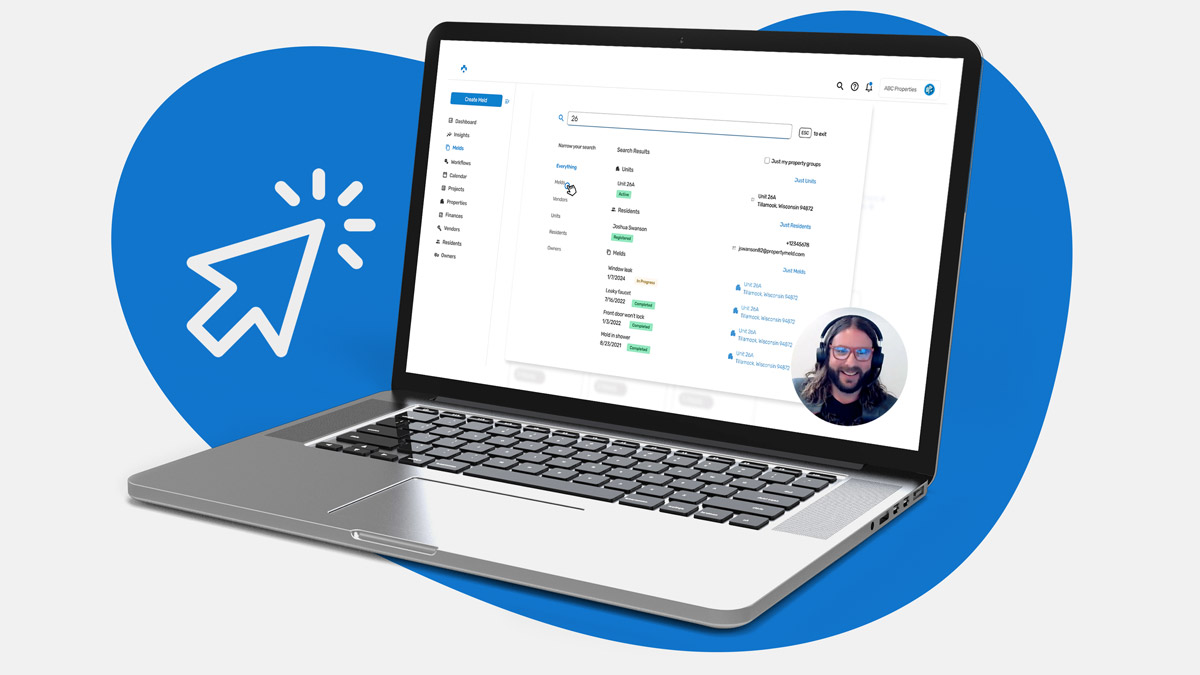
The Property Meld and RentCheck integration puts structured inspection data directly into the maintenance workflow, so decisions can start before the work order. [Link to integration page or demo request]
[Link to webinar recording]