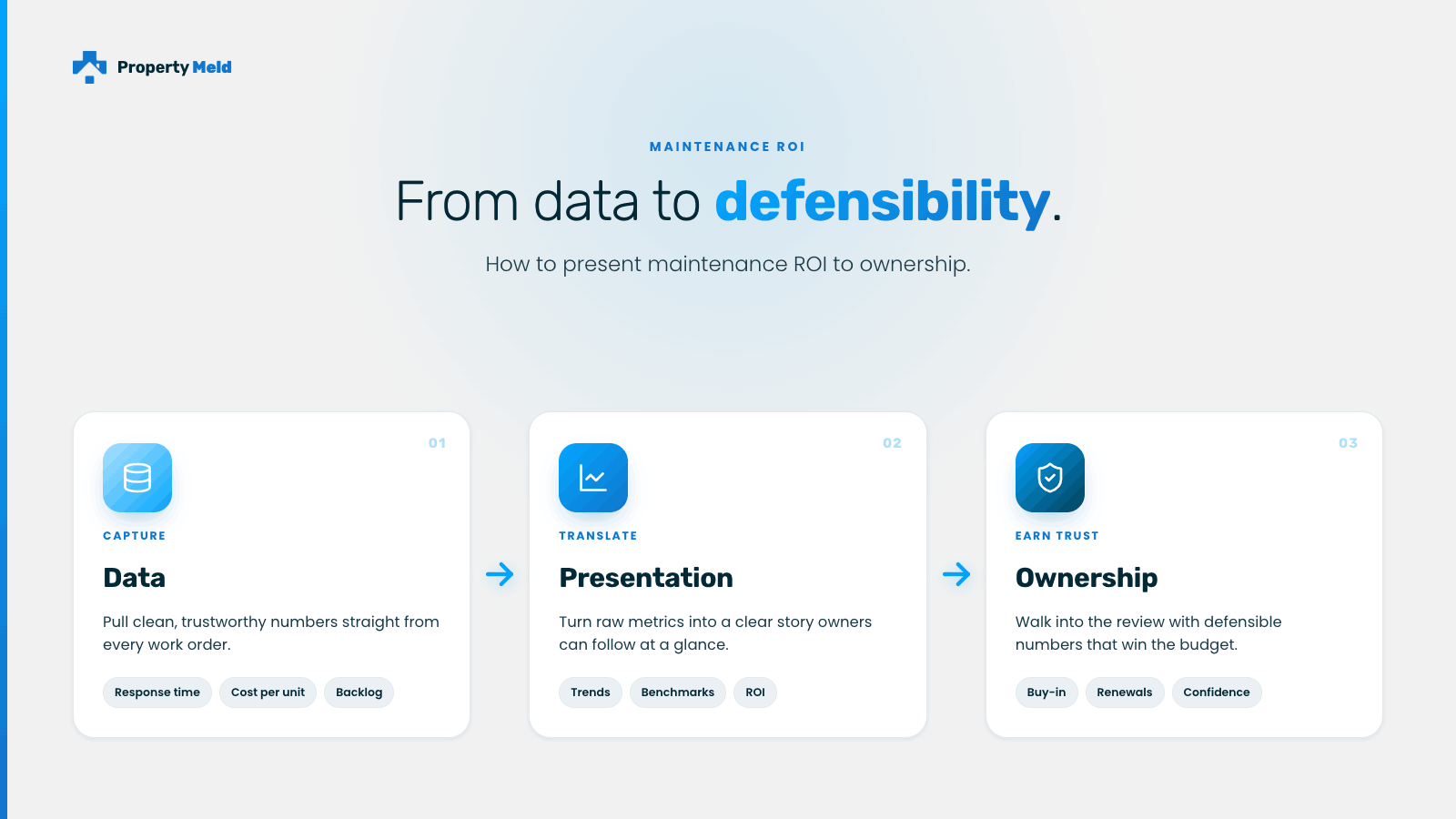
Maintenance ROI is genuinely difficult to isolate. Renewal decisions are influenced by rent price, location, amenities, life circumstances, and maintenance experience all at once. Separating the maintenance contribution from everything else requires either a controlled experiment, which is impractical at scale, or a reasonable proxy model, which is achievable.
Ownership isn’t asking for academic rigor. They’re asking for a reasonable, data-grounded estimate that makes the investment decision defensible. A regression analysis isn’t required. A clear chain of logic supported by actual operational data is.
The ROI chain: how maintenance connects to money
Here’s the chain, step by step. Each link needs to be supported by data from the operation.
| Chain link | Data point needed |
| Maintenance investment (cost) | Total maintenance spend, segmented by category and initiative |
| Operational improvement | Change in time-to-complete, first-time fix rate, res sat before and after |
| Resident experience impact | Maintenance CSAT score correlation to overall satisfaction |
| Renewal rate impact | Renewal rate difference between high-CSAT and low-CSAT maintenance properties |
| Revenue retention | Renewal rate improvement x units x average monthly rent x lease term |
Not every link needs data in every conversation. But the more of the chain that can be shown with actual portfolio numbers, the more defensible the argument becomes.
Building the revenue retention number
This is the most powerful link in the chain and the one most operations leaders underestimate.
Start with what’s known: renewal rate for properties where maintenance satisfaction scores are above the threshold vs. properties where it’s below. Even a rough segmentation produces a workable number.
Then model it out:
- Renewal rate improvement: 5 percentage points, for example from 62% to 67%
- Units in the portfolio: 3,000
- Units affected by the improvement: 3,000 x 5% = 150 additional renewals
- Average monthly rent: $1,600
- Average lease term: 12 months
- Revenue retained: 150 x $1,600 x 12 = $2.88M in retained revenue
Set against that the cost of the maintenance investment that drove the CSAT improvement, and the ROI picture becomes clear. This is a simplified model, but it uses actual portfolio numbers. That’s what makes it defensible.
Building the cost avoidance number
The second financial story is about what didn’t happen. Preventive maintenance investment and vendor network improvements reduce emergency repair frequency. Emergency repairs cost more in direct spend, in after-hours premiums, and in the resident experience damage they cause.
Model it like this:
- Baseline emergency repair rate: how many emergency requests per 100 units per month
- Current emergency repair rate: the same metric after preventive maintenance investment
- Reduction in emergency repairs: the difference multiplied by portfolio size
- Average emergency repair premium: what emergency repairs cost vs. planned repairs in the same category, typically 40 to 60% higher
- Cost avoidance: emergency repair reduction x premium = avoided spend
This is money that didn’t show up on the P&L because it was prevented. That’s harder to see than a line item, but it’s real. Quantifying it changes the conversation about preventive maintenance from cost to investment.
The deferred maintenance risk number
The third story is about financial exposure. Deferred maintenance builds risk on two dimensions: immediate repair cost, since deferred issues tend to become more expensive over time, and asset valuation impact, since portfolios with documented preventive maintenance programs and low deferred maintenance carry higher valuations.
Precise modeling isn’t required. What’s needed is a credible estimate of the current deferred maintenance backlog and a clear connection between the preventive maintenance program and the rate at which that backlog is growing or shrinking.
A statement like: we have X units with flagged deferred maintenance items, these represent Y in estimated future repair cost at current rates, and our preventive maintenance program is projected to address Z% of that backlog in the next 12 months is a risk management story that resonates with asset managers.
Putting it together: the one-page ownership brief
Structure the full argument in four sections, one page, no spreadsheet attachments:
- What we invested: The maintenance programs and platform investments made this year, with total cost.
- What improved operationally: The specific metrics that moved, including CSAT, first-time fix rate, and emergency frequency, with before and after data.
- What that’s worth financially: The revenue retention model, the cost avoidance estimate, and the deferred maintenance risk reduction.
- What we’re watching: The properties or markets where indicators need attention and what’s being done about it.
One page. Four sections. Actual portfolio numbers. That’s what defensible maintenance ROI looks like.
| The hardest part of this framework isn’t the math. It’s having the underlying data to put into it. Property Meld’s portfolio-level reporting provides the before/after operational data, the property-level resident satisfaction correlation, and the vendor performance metrics that make the ROI case credible. |