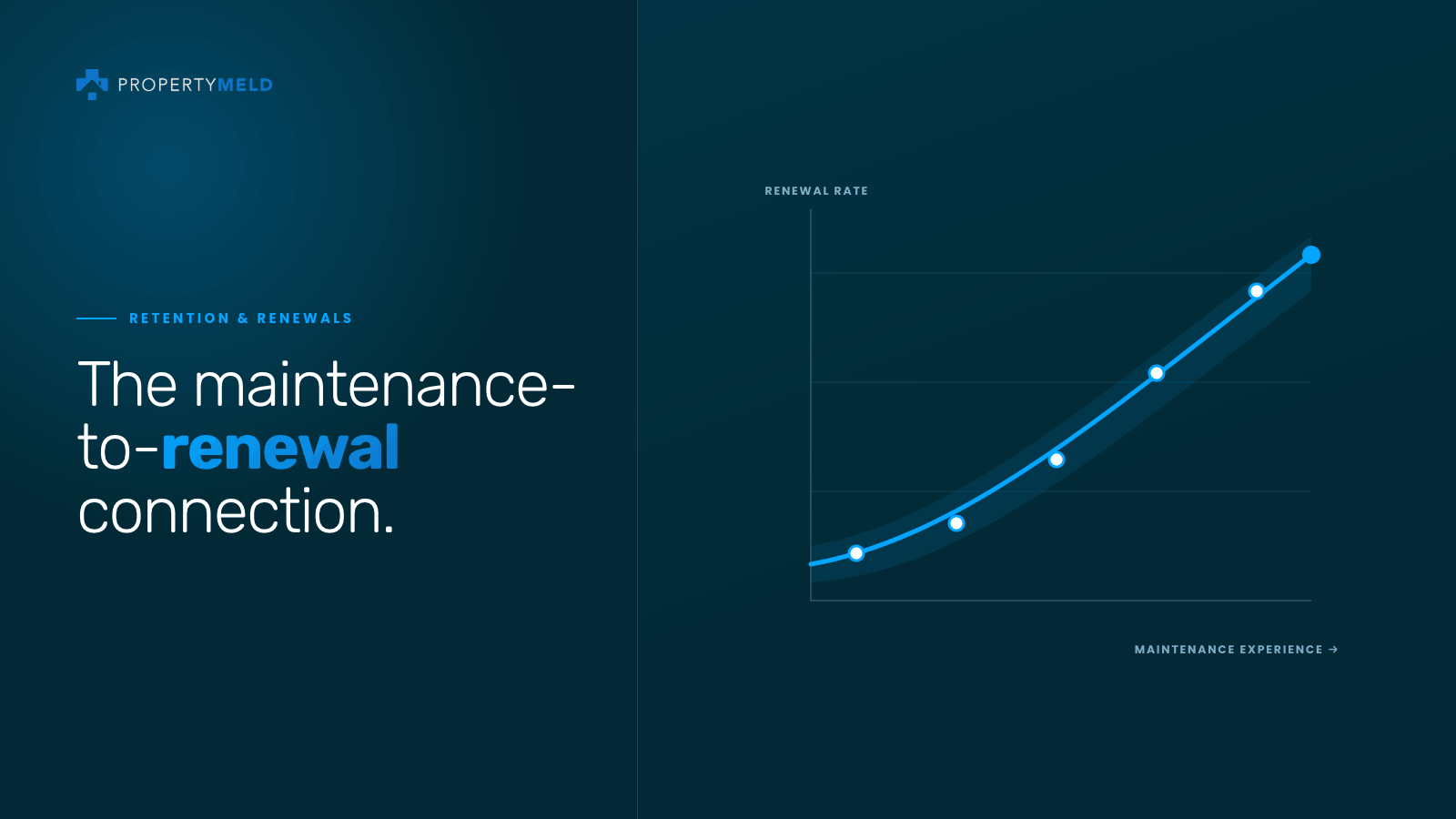
Most operations leaders intuitively believe that maintenance affects resident satisfaction. The question is whether that belief is precise enough to be actionable.
Intuition says: residents who have good maintenance experiences are more likely to renew. Data says: the connection is specific, measurable, and larger than most operators have quantified. And the specific dimensions of maintenance that drive renewals are not always the ones getting the most operational attention.
Here’s what the research and operational data actually show about the maintenance-to-renewal connection and what it means for how large portfolios should be running their maintenance programs.
What residents say drives renewal decisions
Resident survey research consistently places maintenance experience among the top three factors in renewal decisions, alongside rent price and location. In most studies, maintenance ranks above amenities, above community features, and above property age or condition.
What makes this finding operationally significant is that rent price and location are largely fixed variables for an existing resident. Maintenance experience is the variable operators control most directly. It’s also the one that changes the math on renewal decisions most readily when it’s managed well or poorly.
Within maintenance experience, the research points to two specific dimensions that matter most:
- Responsiveness: Not just how fast the work gets done, but how quickly the resident receives a response after submitting a request. Acknowledgment within a defined window, even when completion takes longer, has a measurable positive effect on satisfaction. Silence, even when the request is in progress, has a measurable negative effect.
- Communication throughout the process: Residents who receive status updates throughout the lifecycle of a request rate their maintenance experience significantly higher than residents whose only communication is completion confirmation. The updates don’t have to be frequent. They have to be consistent.
| Residents don’t require fast maintenance. They require responsive maintenance. The distinction matters because fast completion with no communication produces lower satisfaction scores than slower completion with consistent updates. |
Why the effect is stronger in single-family rental
A resident who has lived in a home for two or three years has arranged furniture, painted rooms, set up outdoor space, and built routines around the property. The friction cost of moving is significantly higher than it is for an apartment resident. That friction cost means SFR residents are stickier than apartment residents, but it also means their satisfaction threshold for staying is higher. A maintenance experience that a multifamily resident might tolerate is more likely to push an SFR resident to consider moving because the bar for justifying the disruption of a move is set higher by how much they’ve invested in the home.
For large SFR operators, this creates both a risk and an opportunity. The risk: poor maintenance experience can motivate a move decision even when the resident has strong reasons to stay. The opportunity: excellent maintenance experience builds a level of resident loyalty that’s difficult for competing properties to replicate.
The specific operational failures that drive non-renewals
Resident exit interviews and satisfaction surveys point to a consistent set of maintenance-related reasons for non-renewal:
- A request submitted and never acknowledged within a reasonable window. The resident concludes that the management company isn’t responsive and starts considering alternatives.
- A request completed but the resident had no visibility into when it would happen. Time was taken off work for a maintenance visit that wasn’t confirmed in advance.
- A repeat request for the same issue, resolved inadequately the first time. The resident loses confidence that the issue will ever be fully addressed.
- An emergency request handled slowly or through an unclear process. The resident questions whether the management company is equipped to handle problems that matter.
Each of these is a specific, correctable operational failure. None requires better technicians or more staff. All require better communication processes and better visibility into what’s happening at the property level.
Quantifying the connection for ownership conversations
The most common challenge operations leaders face with the maintenance-to-renewal connection isn’t believing it. It’s quantifying it in a form that ownership and asset management respond to.
Here’s a framework for building that number:
- Segment properties by maintenance CSAT score into high, medium, and low performing groups
- Compare renewal rates across those segments, controlling for market and rent variables as best as possible
- Calculate the renewal rate difference between high and low performing segments
- Apply that difference to total portfolio units and average monthly rent to produce an estimated revenue retention impact
Operations leaders who have built this number, even approximately, report that it changes the budget conversation permanently. Maintenance stops being defended as a necessary cost and starts being presented as a driver of the revenue retention metric that ownership already cares about.
For more information, check out our maintenance renewal report that dives into this data.
Where to start connecting the data
Building the maintenance-to-renewal connection starts with having maintenance satisfaction data tied to specific properties and timeframes. That requires a maintenance platform that collects satisfaction scores at the request level rather than through periodic portfolio-wide surveys.
Once request-level satisfaction data is available, the correlation to renewal rates becomes something that can be calculated from existing data. The portfolio already knows which residents renewed. The maintenance platform knows how those residents rated their maintenance experience. The connection is in the data. The question is whether the system is built to surface it.
| Property Meld captures maintenance satisfaction data at the request level and connects it to portfolio-level performance views. For operations leaders ready to build the maintenance-to-renewal case with their own data, the starting point is a property maintenance operations platform. |