If you’re searching for a better way to handle after-hours maintenance, you’ve likely run into two categories of solution: property management answering services (live agents who pick up your calls after hours) and AI-powered triage systems (software that engages residents and assesses urgency without a human on the line).
Both categories claim to solve the same problem. Both have real merits. And the right choice genuinely depends on your portfolio, your team, and what you need the system to actually do.
This post gives you a clear, honest comparison, what each approach does well, where each falls short, and the questions that should drive your decision.
What property management answering services do
A property management answering service is a staffed service that answers calls on your behalf when your office is closed. Agents follow custom scripts you provide, handle maintenance reports, triage emergencies according to your protocols, dispatch vendors or notify on-call staff for genuine emergencies, and log or forward non-urgent issues for your morning team.
Where answering services fall short
The limitations of live-agent answering services are structural, not a matter of quality.
Triage consistency. An answering service is only as consistent as its scripts and its agents. Different agents make different judgment calls on the same scenario. Scripts can’t anticipate every situation. The result is triage quality that varies by agent, time of night, and call volume, which means your escalation and dispatch decisions are inconsistently made.
Knowledge gaps. A third-party agent doesn’t know your properties, your vendors, your history with specific residents, or the quirks of your systems. They work from whatever information you’ve given them in onboarding. Gaps in that knowledge show up at the worst possible moments, when something unusual happens and the agent has to improvise.
Data friction. Interactions that happen outside your property management platform have to get back in somehow. Typically this means voice transcripts, email summaries, or CSV exports that a morning coordinator has to reconcile manually. That daily friction is small per incident and large in aggregate.
Cost at scale. Per-minute billing models mean your costs spike during high-volume periods, cold snaps that drive HVAC calls, storms that generate water intrusion reports, move-in season. The months when you most need coverage are the months when it costs the most.
Coverage gaps. Some services staff differently after midnight or on holidays. “24/7” in a contract doesn’t always mean identical service quality around the clock. Agent fatigue and staffing decisions at 3 AM on a holiday weekend affect what your residents experience.
What AI maintenance triage does
AI-powered maintenance triage uses conversational AI to handle the same functions a live agent performs, engaging residents, asking diagnostic questions, assessing urgency, routing emergencies, and logging non-urgent issues, without requiring a human on the other end of every interaction.
The appeal is consistency. An AI system applies the same criteria to every interaction at any hour. It doesn’t have bad nights. It doesn’t improvise when the script runs out. It doesn’t cost more because it’s a cold Tuesday in January and your HVAC calls are spiking.
More importantly, purpose-built AI maintenance triage, systems trained specifically on property maintenance data, not general-purpose AI tools, can make triage decisions that are more accurate than human agents following scripts. The deciding factor is the data behind the system. An AI trained on millions of real maintenance work orders across thousands of properties knows things about maintenance patterns that no script can capture.
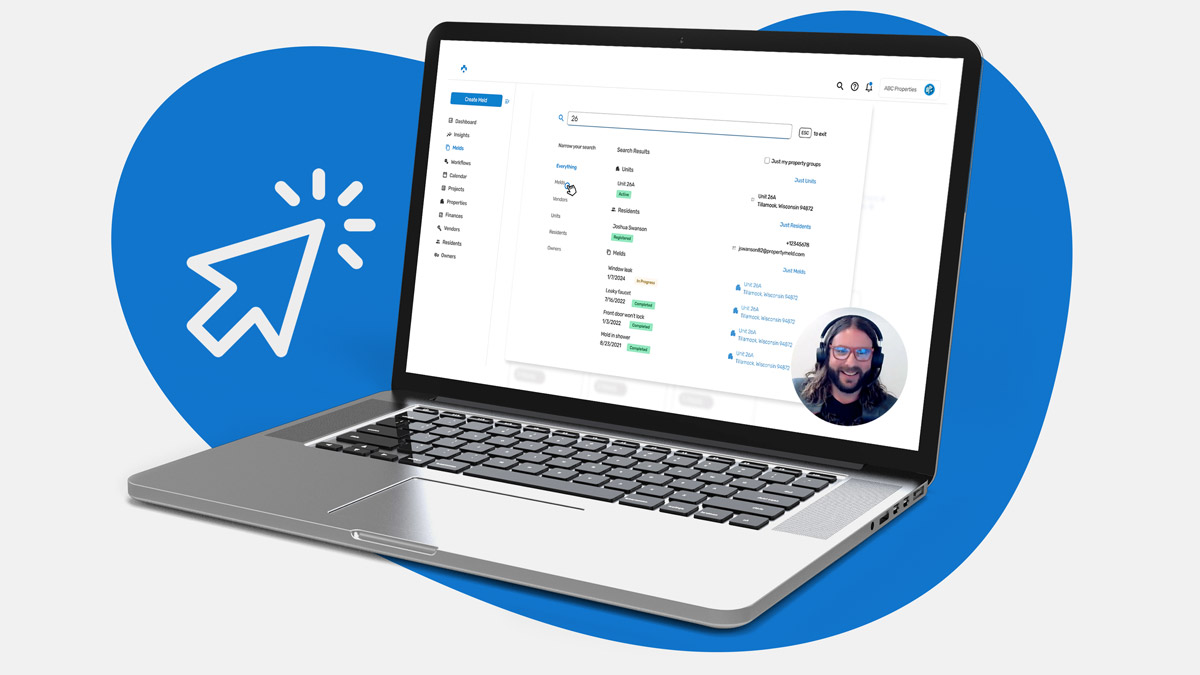
Property Meld’s MAX™ On-Call is purpose-built for exactly this. Trained on more than a decade of real maintenance data, integrated directly into the Property Meld platform.
Where AI triage has limitations
A fair comparison requires acknowledging where AI triage currently falls short of live agents.
Highly distressed residents. A resident who is panicking, genuinely frightened about a safety situation, or already frustrated by a history of poor maintenance responsiveness, may not engage well with a text-based AI interaction. Human empathy in those moments is real and valuable. The best AI systems are designed to recognize distress and escalate to a human quickly, but the initial moments of a distressed interaction are still a gap.
Truly novel scenarios. AI systems make decisions based on patterns in their training data. A situation that falls entirely outside those patterns, an unusual equipment failure, a highly specific safety scenario , may not be handled with the nuance a well-trained human agent would bring. Good systems escalate when uncertain; less good ones may misclassify.
Resident preference. Some residents, particularly in older demographics, prefer speaking to a human. If a significant portion of your resident base is likely to be frustrated or disoriented by an AI interaction, that’s a real consideration in your decision.
Setup and integration. AI triage systems require initial configuration, property-specific information, escalation protocols, vendor lists, on-call rosters. That setup investment is real, though it typically pays back quickly once the system is running.
A direct comparison: the key decision dimensions
Here’s how the two approaches compare across the dimensions that matter most for property management decisions:
Triage consistency
AI wins here. The same criteria applied to every interaction, every night, regardless of who’s on shift or how tired they are. For property management companies with legal or liability sensitivity around emergency escalation decisions, consistency has operational and risk value that’s hard to quantify but easy to understand.
Integration with your workflow
AI systems built into your property management platform win decisively. Interactions that happen inside your platform generate work orders, documentation, and data that your team can act on immediately, no reconciliation, no re-entry, no morning friction. Third-party answering services always create some degree of data handoff friction.
Cost predictability
AI triage on a subscription model wins for portfolios with variable call volume. Per-minute billing for answering services means your highest-need months are your most expensive months. Flat subscription pricing for AI triage means cost is predictable regardless of volume.
Quality ceiling
This depends entirely on the specific system. A purpose-built AI trained on years of maintenance data has a higher quality ceiling than a generic answering service following a script. A mediocre AI has a lower quality ceiling than an excellent specialized answering service. Evaluate the specific system, not the category.
So which is right for your portfolio?
There’s no universal answer, but there is a clear framework.
AI triage is likely the better fit if you’re managing 150+ units and the volume of after-hours interactions makes consistent human triage difficult to sustain, if you’re already using Property Meld and want coverage that integrates directly into your existing workflow, if cost predictability matters and your volume spikes seasonally, or if you’ve been burned by inconsistent triage from a call center service and need something more reliable.
For many property management companies, the more interesting question isn’t which category wins, it’s whether your current approach (whichever it is) is actually delivering on what 24/7 coordination is supposed to accomplish: consistent triage, reliable escalation, clean morning handoffs, and a resident experience that doesn’t create friction at the worst possible moment.
The question isn’t “answering service or AI?” , it’s whether your current after-hours system is actually doing what 24/7 coordination is supposed to do.
Property Meld’s approach
MAX™ On-Call is Property Meld’s AI-powered after-hours triage solution, built on more than a decade of real maintenance data, integrated directly into the Property Meld platform, and designed to handle the full intake-to-routing loop without requiring a human for every interaction.
It handles the 40% of reported emergencies that aren’t actually emergencies, triaging them correctly before an unnecessary overnight dispatch goes out. It escalates genuine emergencies with full documentation. It delivers an organized queue to your morning coordinator instead of a pile of messages to sort through. And it gets smarter over time as it processes more data from your specific portfolio.
If you’re currently using an answering service and wondering whether AI triage would serve your portfolio better, it’s a conversation worth having.