Every operations leader who has built a strong in-house maintenance team at one property or in one market knows the satisfaction of a team that runs well. Fast response times. High first-time fix rates. Residents who know who’s coming and when. A coordinator who rarely gets surprised.
Then the portfolio grows. New markets. New properties. New technicians who weren’t trained by the people who built the original culture. And somewhere along the way, the consistency that made the original operation work stops being a given and starts being something that has to be actively maintained.
That’s the standardization challenge at large portfolios. It’s not a hiring problem or a training problem in isolation. It’s a systems problem. The practices that produce good maintenance outcomes need to be encoded into the tools and processes the team uses daily, not carried in the heads of the original team members who figured it out years ago.
Why standardization breaks down at scale
- Institutional knowledge doesn’t transfer: The coordinator who’s been with the organization for six years knows which technicians are best for complex HVAC, which properties have chronic issues, and which residents need extra communication. That knowledge is genuinely valuable. It’s also completely non-transferable without a system to capture and surface it. When that coordinator leaves or moves to a different region, the knowledge leaves with them.
- Training produces inconsistent outcomes: Two technicians can go through the same onboarding program and come out running meaningfully different processes because training conveyed principles rather than procedures. Without a platform that guides the day-to-day workflow, individual interpretation fills the gap between what was trained and what gets done.
- Performance expectations stay informal: In a small operation, a supervisor knows when a technician is underperforming through direct observation. In a large portfolio, performance gaps hide in aggregate metrics. A technician whose first-time fix rate is 20 points below the team average might never surface in a portfolio-level report because the overall numbers look acceptable.
- Regional variation becomes the norm: Without centralized performance visibility, regional managers develop their own interpretations of what good looks like. Over time, the maintenance operation in one region looks meaningfully different from the operation in another, not because the assets or residents are different, but because the standards have drifted.
| Standardization doesn’t mean every technician does exactly the same thing in every situation. It means the process that guides how they work is consistent enough that performance is comparable, improvable, and not dependent on who trained whom. |
The three layers of in-house maintenance standardization
Layer 1: Process standardization
Process standardization defines how maintenance requests move from submission through completion consistently across every property and every technician. This includes:
- How requests are triaged and prioritized, with clear criteria rather than coordinator judgment calls
- How technicians receive, accept, and update assignments in real time rather than through end-of-day check-ins
- How completion is documented, including what information is required before a request can be closed
- How residents receive communication at each stage of the process and what triggers that communication
Process standardization is the layer most operations leaders address first because it’s the most visible. The challenge is that a well-documented process doesn’t automatically produce consistent behavior. It produces consistent behavior when the tools technicians use every day make following the process easier than not following it.
This is where the technician mobile app becomes operationally significant. A well-built tech app doesn’t just give technicians access to their assignments. It structures the workflow so that the standardized process is the natural path through the day. Accepting a request, documenting arrival, capturing completion photos, logging parts used, confirming resident sign-off: these steps happen in sequence because the app guides them, not because each technician independently remembers to do each step.
| Standardization sticks when the standardized process is the easiest process. A tech app that guides technicians through a consistent workflow produces more standardization than a training manual that asks them to remember one. |
Layer 2: Performance standardization
Performance standardization establishes what good looks like across the industry and makes individual performance visible against that standard. Without this layer, process standardization produces consistent workflows but not necessarily consistent outcomes.
This requires tracking technician performance at the individual level, segmented by category, across three dimensions:
- Completion quality: first-time fix rate by technician and by category, which reveals whether the standardized process is producing the right outcomes or just consistent activity
- Completion efficiency: time from assignment acceptance to completion, which reveals whether workload and routing are enabling or constraining performance
- Documentation quality: completeness of completion records, which determines whether the data produced by the standardized process is actually usable for operational decisions
The data for these metrics already exists in a well-instrumented maintenance platform. The question is whether it’s surfaced at the individual technician level in a way that operations leaders can act on, or whether it’s aggregated into portfolio averages that obscure individual variation.
Property Meld’s data tracking surfaces individual technician performance in real time, segmented by category, so regional managers and operations leaders can see where the standardized process is producing the intended outcomes and where it isn’t. That visibility is what makes performance standardization an operational reality rather than an aspiration.
Layer 3: Continuous improvement standardization
The third layer is the mechanism that keeps the first two layers improving over time rather than drifting. This is the hardest layer to build and the one most often missing from in-house maintenance programs at large portfolios.
Continuous improvement standardization means:
- Performance data is reviewed on a regular cadence at the team and individual level, not just when a problem becomes visible
- Insights from high performers are systematically captured and distributed rather than staying in one region
- Process refinements get implemented consistently across the portfolio rather than locally by individual regional managers
- New technicians come into a system where the best practices of the existing team are embedded in the tools they use, not just in the knowledge of the colleagues who trained them
This layer is where the platform choice becomes most consequential. A maintenance platform that captures rich completion data, tracks individual performance over time, and makes that data comparable across markets is the foundation for continuous improvement that compounds. A platform that captures transactions without the analytical layer produces the same operational snapshot every month without the ability to learn from it.
What standardization looks like in practice
| Operational scenario | How standardization handles it |
| New technician joins a regional team | Onboarding to the tech app guides them through the standardized workflow from day one. Performance tracking begins immediately. Regional manager sees their metrics alongside the team within the first week. |
| A technician’s first-time fix rate drops in one category | Performance dashboard surfaces the drop before it affects resident satisfaction scores. Regional manager can intervene with training or assignment adjustment before it compounds. |
| A property starts falling behind portfolio averages | Portfolio-level visibility flags the drift. Operations leadership can distinguish between a technician performance issue, a scheduling issue, and a property-level demand spike. |
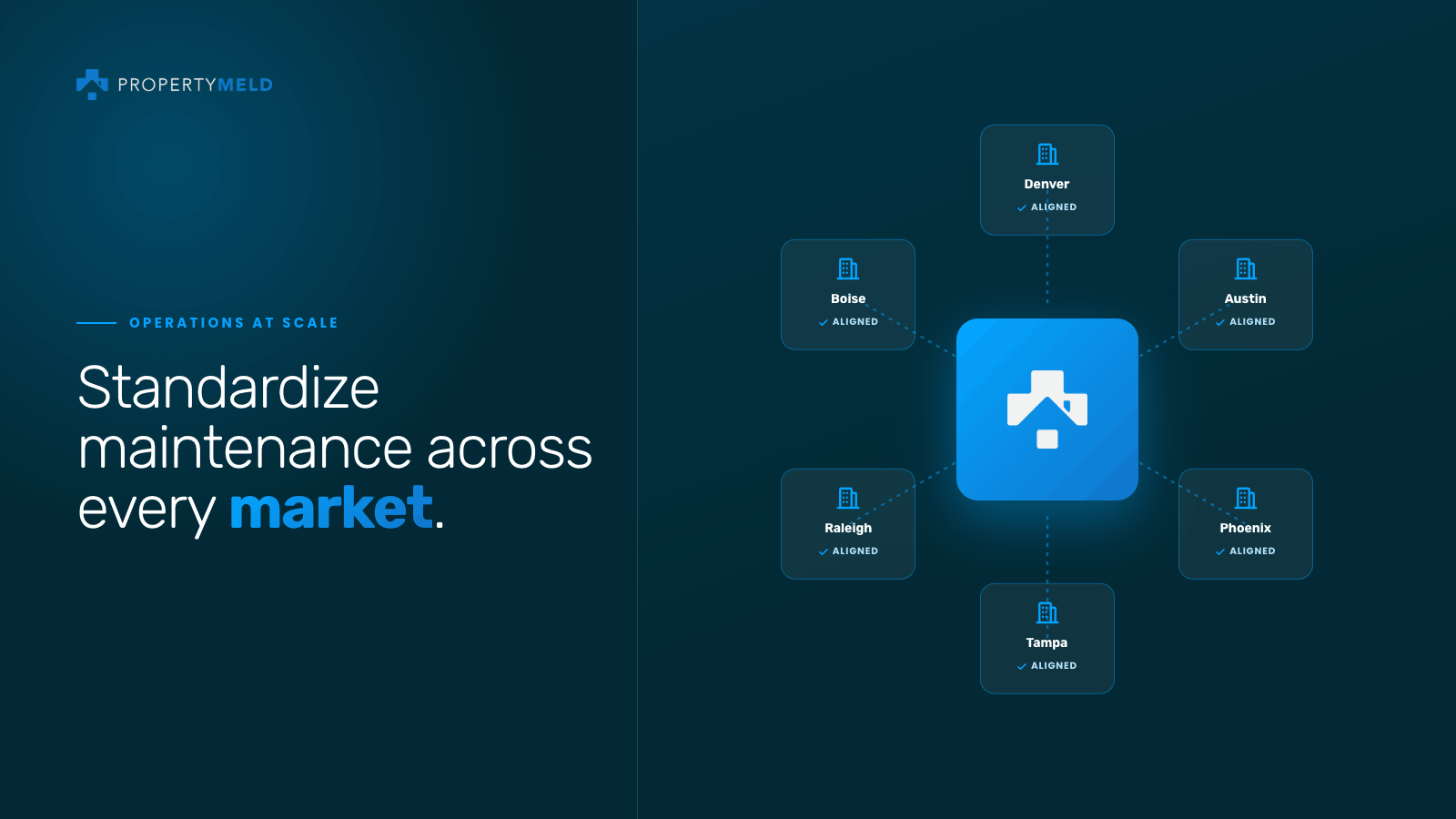
| A process improvement is identified in one market | The improvement is documented in the platform workflow and rolled out across other markets. All technicians benefit from what one market learned. |
| A senior technician with deep institutional knowledge leaves | The knowledge they contributed is embedded in completion records, performance benchmarks, and documented workflows rather than leaving with them. |
The role of the technician mobile app in making standardization stick
The technology that makes in-house maintenance standardization durable at large portfolios isn’t a training platform or a performance management system. It’s the tool technicians use every single day to do their jobs.
A well-designed technician mobile app does several things that matter for standardization:
- Presents assignments with all relevant context attached: property history, resident notes, prior request details, access instructions. Technicians arrive prepared rather than figuring out what they need on site.
- Guides completion documentation through a structured workflow rather than a blank notes field. Completion records that follow a consistent format are comparable, searchable, and useful for operations decisions.
- Enables real-time status updates that flow automatically to residents and coordinators without the technician making a separate communication action. The update happens as a natural part of completing the workflow step.
- Captures the data that feeds individual performance tracking automatically, as a byproduct of doing the job rather than as a separate reporting burden. Technicians who don’t have to manually report their performance are more likely to use the system consistently.
Property Meld’s technician app is built around exactly these principles. The workflow guides technicians through the standardized process. The data it captures feeds the performance tracking that makes individual and team performance visible at the operations level. The two layers reinforce each other: the app makes the process easy to follow, and the data it produces makes deviations visible.
Measuring whether standardization is working
| Metric | What it measures | Target signal |
| First-time fix rate variance across technicians | Whether skill and process consistency is distributed across the team | Tightening distribution over time, not just rising average |
| Completion documentation completeness rate | Whether the standardized process is being followed through to the end | 95%+ of completions with all required fields populated |
| Time from assignment to acceptance | Whether technicians are engaging with the workflow in real time | Under 15 minutes during business hours as a portfolio standard |
| Resident satisfaction variance by technician | Whether the resident experience is consistent regardless of which technician handles a request | Low variance across the team, not just high average |
| Process adherence in new markets | Whether standardization transfers to new regions and properties effectively | New markets reach portfolio norms within 60 to 90 days of launch |
The pattern that indicates genuine standardization is tightening variance rather than just rising averages. When the gap between the best and worst performers is shrinking over time, the system is encoding good practices across the team. When the average is rising but the variance holds steady, the best performers are getting better while the rest of the team isn’t catching up. That’s individual talent, not systematic standardization.
| Property Meld’s technician app and performance tracking tools are built to make standardization a byproduct of daily operations rather than an overlay on top of them. For operations leaders ready to close the gap between how their best properties run and how every property runs, looks into a Property Maintenance Operations platform. |