There’s a version of this story that plays out at a lot of property management companies.
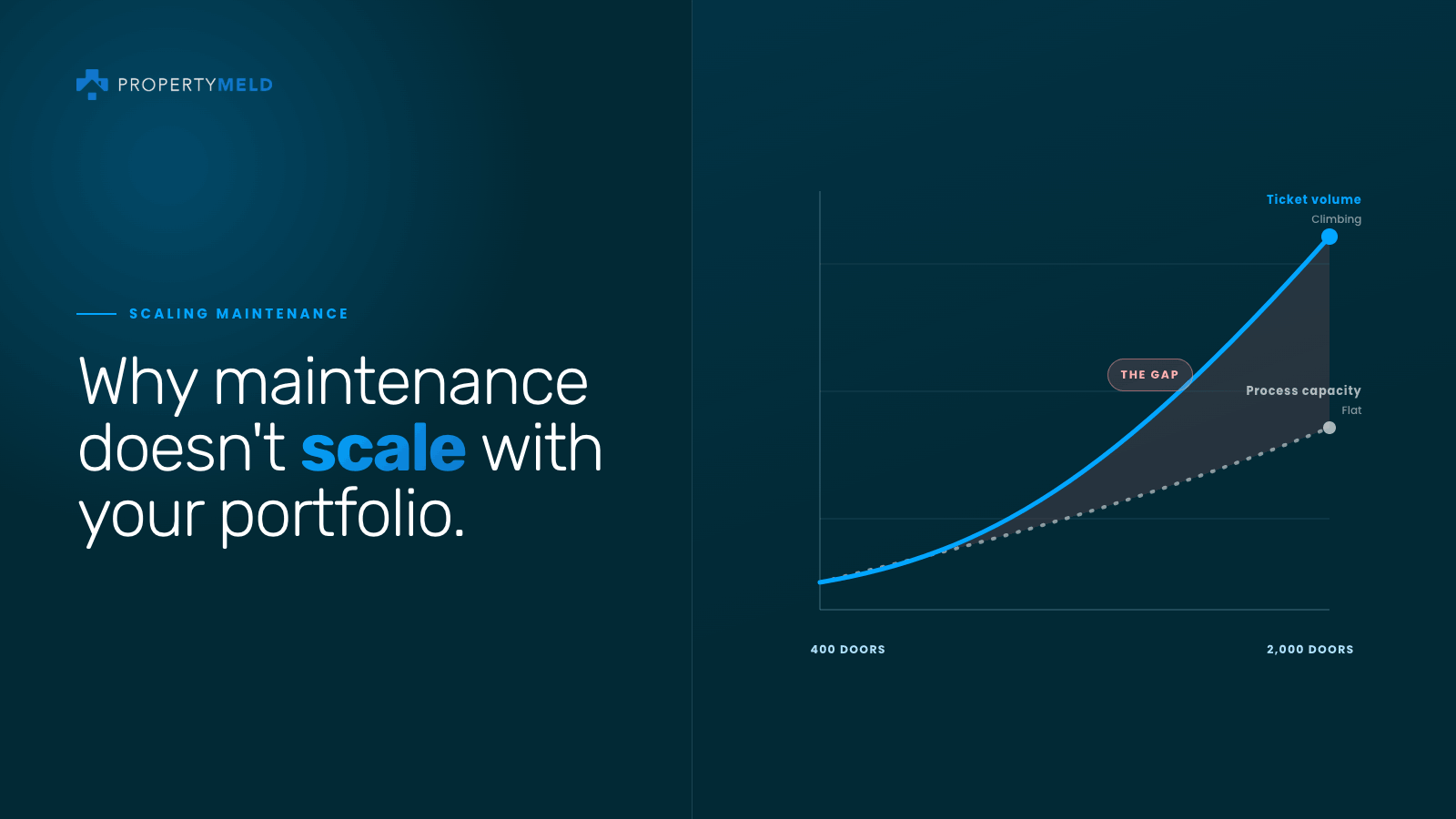
Maintenance worked fine at 400 doors. The team knew the properties. Coordinators knew the residents. Problems got handled because everyone was close enough to see them. Then the portfolio grew. Staff was added to match the volume. And somewhere around 1,500 or 2,000 doors, something changed. Complaints started coming in from properties that used to run smoothly. Coordinators were overwhelmed despite reasonable headcount. The operation that worked at 400 doors was visibly struggling at 2,000.
The instinct is to hire. More coordinators. More technicians. Sometimes that helps. More often, it scales the problem rather than solving it.
Here’s what’s actually happening and why the fix isn’t more staff.
The scale problem isn’t volume. It’s complexity.
Adding doors to a portfolio doesn’t just increase the number of maintenance requests. It increases the number of variables that determine how well those requests get handled.
At 400 doors, a coordinator can hold most of the relevant context in their head. Which technicians are reliable for which categories. Which properties have aging systems. Which residents tend to submit vague requests that need a follow-up before dispatch. That context works because the portfolio is small enough to manage personally.
At 2,500 doors, that model breaks. There’s too much context to hold. Too many technician performance patterns to track informally. Too many properties with different histories. The mental model that worked at 400 doors becomes a liability at 2,500 because it creates a ceiling on what the operation can know about itself.
This is the scale problem. Not volume. The operational complexity that volume creates, and whether the system is built to manage that complexity or just absorb it.
| Maintenance scales when the process produces consistent outcomes regardless of portfolio size. It doesn’t scale when consistent outcomes depend on individual coordinators knowing everything. |
The five ways scaling breaks maintenance
1. Coordinator knowledge becomes a bottleneck
When maintenance performance depends on individual coordinators knowing their properties and technicians personally, the operation scales only as fast as those coordinators can absorb new context. Slowly. Inconsistently. And in a way that creates a single point of failure when a coordinator leaves.
Well-run operations at scale encode that context into the system. Technician performance data lives in a dashboard, not a coordinator’s memory. Property histories are documented and accessible. Dispatch decisions are guided by data rather than relationship knowledge.
2. Technician performance becomes invisible
At small portfolios, a supervisor knows when a technician is underperforming through direct observation. At 2,500+ doors, performance gaps hide in aggregate metrics. A technician whose first-time fix rate is 20 points below the team average might never surface in a portfolio-level completion report because the overall numbers look acceptable.
Individual performance visibility is what enables coaching, rebalancing, and improvement. Without it, underperformance accumulates quietly until it becomes a resident satisfaction problem.
3. Resident communication becomes inconsistent
At small portfolios, coordinators can personally follow up with residents on active requests. That level of attention isn’t scalable. As volume grows, some residents get proactive updates and some don’t, depending on which coordinator handled their request and how busy that coordinator was.
The residents who don’t hear back call in. Those calls consume coordinator capacity. Which makes it harder to follow up with other residents. Which generates more inbound calls. The cycle compounds.
4. Performance variance becomes invisible
At small portfolios, variance is noticeable. If one property is running slowly, someone knows. At 2,500+ doors, variance between properties can persist for months before anyone connects the dots. Property A runs a 2-day average completion time. Property B runs 11 days. Both sit inside the same portfolio average, which looks acceptable, while residents at Property B are having a fundamentally different experience.
Invisible variance is expensive. It produces inconsistent resident satisfaction, variable renewal rates, and operational inefficiency that accumulates quietly until it shows up as a business problem.
5. Data and decision-making fall out of sync
At small portfolios, decisions get made on current information because the portfolio is small enough to observe directly. At scale, information lives across multiple systems, gets updated manually, and arrives as a monthly report that reflects what was happening three weeks ago.
Decisions made on stale data compound the performance gaps they’re supposed to address.
What scaling actually requires
Operations leaders who successfully scale maintenance share a consistent approach. They stop treating maintenance as a service to be delivered and start treating it as a system to be managed.
That shift has three practical implications:
- Process before headcount. Before adding staff to address a maintenance problem, the question becomes: is the current process producing consistent outcomes with current staff? If not, adding headcount scales the process, not the performance.
- Visibility before intervention. Before making operational decisions, the question becomes: is the data current, comparable, and accessible enough to support the decision? If not, the intervention may be solving the wrong problem.
- Systems before relationships. Before relying on a coordinator or technician relationship to manage performance, the question becomes: is that performance tracked systematically in a way that would surface a problem before it compounds?
The operational checklist for scale readiness
| Operational capability | Not ready for scale | Ready for scale |
| Technician performance tracking | Visible only through supervisor observation | Individual performance data tracked in real time by category |
| Resident communication | Manual follow-ups by coordinator | Automated status updates throughout the request lifecycle |
| Performance visibility | Monthly report requiring manual assembly | Real-time dashboard comparable across all properties |
| Coordinator workload | Visible only to individual coordinators | Portfolio-wide workload distribution visible to operations leadership |
| Maintenance ROI | Defended as a cost line | Connected to renewal rate and revenue retention with data |
Operations leaders who assess their program honestly against this matrix usually find two or three categories where the operation is still running on the small-portfolio model. Those are the gaps worth closing first.
| Property Meld is built to close these gaps. Systematic technician performance tracking, automated resident communication, real-time portfolio visibility, and the reporting infrastructure that connects maintenance performance to business outcomes. |