There’s no shortage of things that could be tracked in a maintenance operation. Request volume. Technician utilization. Parts spend. Seasonal trends. Category breakdowns. The list goes on.
The problem isn’t a lack of data. It’s figuring out which numbers actually matter: the ones that predict outcomes, expose problems early, and give operations leaders something actionable to work with. Everything else is noise.
Here are the 6 property maintenance metrics that operations leaders at large portfolios consistently come back to and what each one actually tells you.
1. Time-to-complete (and its variance)
Time-to-complete measures the distance from when a resident submits a maintenance request to when it’s marked resolved. It’s the most visible metric and the one residents care about most directly.
But the number most operators watch, the portfolio average, is only half the story. The other half is variance: the spread between the fastest and slowest properties. Large variances between properties means the operation is unpredictable. Residents in different properties are having fundamentally different experiences.
Operations leaders should track both. Setting a target average and a maximum acceptable variance is what drives operational consistency, not just a good average.
| Industry benchmark: top-performing portfolios average speed of repairs between 3.4 and 6.8 days. Property Meld’s monthly benchmark report has current industry data broken down by portfolio size. |
2. First-time fix rate
First-time fix rate measures the percentage of maintenance requests resolved in a single visit, with no callbacks, no follow-ups, and no second dispatch.
This metric is a proxy for operational quality. A low first-time fix rate signals one of three things: requests aren’t being diagnosed well before dispatch, vendors are arriving without the parts or information they need, or the scope of work isn’t being defined clearly enough for complete resolution on the first visit.
Every callback costs roughly 1.5 to 2x the original visit in combined labor, scheduling, and resident experience impact. First-time fix rate improvements compound quickly.
3. Resident maintenance satisfaction
Maintenance satisfaction, whether tracked as CSAT, NPS, or a simple post-completion survey score, is the most important leading indicator for renewals.
The research is consistent: maintenance experience is one of the top factors in a resident’s renewal decision. And unlike rent price or location, it’s something operators can directly control.
The operational value of tracking this isn’t just the score. It’s the correlation. When properties with maintenance CSAT above a threshold renew at a measurably higher rate, a satisfaction metric becomes a revenue metric. That’s a fundamentally different conversation with ownership.
Tracking this per property rather than just at the portfolio level matters. The distribution tells a more accurate story than the average.
4. Cost per maintenance request
Total maintenance spend divided by completed requests, segmented by category and market. This is the financial efficiency metric where budget conversations get grounded in something other than instinct.
Tracking it over time and across markets reveals the real story. Steady cost-per-request with increasing request volume is an efficiency story. Rising cost-per-request with flat volume is a pricing or repeat-visit story. The trend matters more than any single period’s number.
Segmenting by category before drawing conclusions is essential. HVAC requests cost more than lock changes. The mix of request types in a given month shapes cost-per-request significantly. Comparing like for like produces more useful insights.
5. Maintenance contribution to renewal rate
This is the hardest property maintenance metric to measure and the most important one to own.
The methodology: isolate properties or cohorts where maintenance satisfaction is high and compare their renewal rates to properties or cohorts where it’s low. Control for other variables as best as possible. The gap is the maintenance contribution estimate.
Even a rough estimate produces something powerful: a number that connects operational performance to revenue. When a 10-point improvement in maintenance CSAT is associated with a 4% improvement in renewal rate, and that improvement across a portfolio represents a specific dollar amount in retained revenue, operations leaders are no longer running a cost center. They’re running a retention program.
6. After-hours and emergency response time
Most metrics measure routine performance. This one measures the floor.
After-hours emergency response time measures how fast legitimate emergencies get acknowledged, dispatched, and resolved outside business hours. It’s the liability and trust metric. Slow response to a water intrusion, a heat failure in winter, or a security issue doesn’t just affect one resident’s satisfaction. It creates legal exposure, can affect neighboring units, and produces the kind of negative reviews that follow a brand for years.
This should be tracked separately from routine maintenance with a specific target for each emergency tier. Misses should be treated as incidents, not just data points.
How to use these together
None of these metrics is as useful in isolation as it is in combination. The patterns that matter most:
| If this metric is low… | And this one is also low… | The problem is likely… |
| First-time fix rate | Vendor SLA compliance | Vendor quality or dispatch process |
| Resident CSAT | Time-to-complete | Speed and communication, not quality of work |
| Resident CSAT | First-time fix rate | Quality of resolution, not speed |
| Cost per request | First-time fix rate | Repeat visits inflating labor cost |
| Renewal rate | Maintenance CSAT | Maintenance experience driving churn |
Used together, these metrics give operations leaders a complete operational picture, not just of how maintenance is performing today, but where the problems are, what’s causing them, and what to fix first.
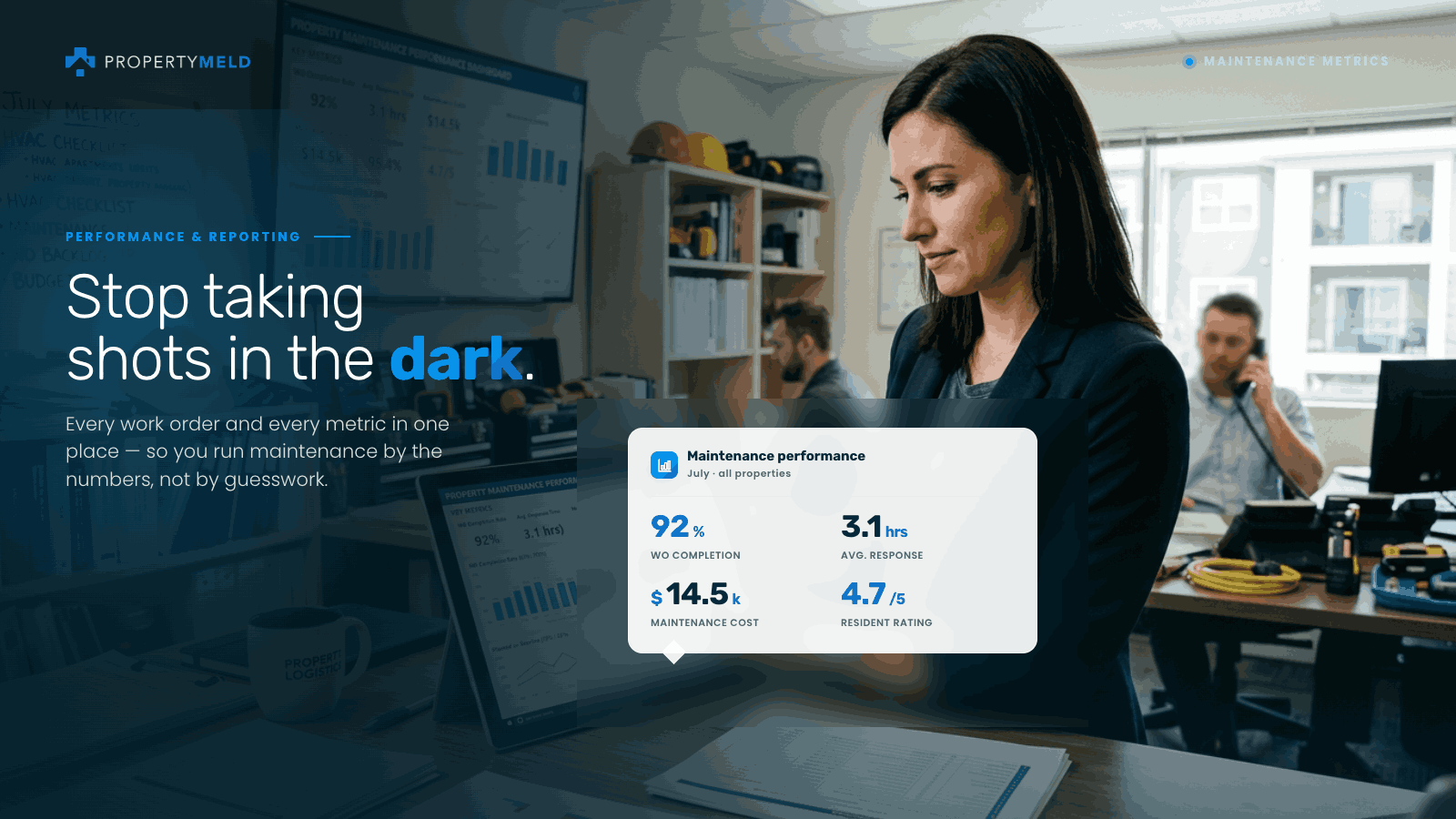
| Property Meld tracks all of these metrics (any many more) in real time, broken down by property, region, vendor, and category. |